EUSIPCO 2026: one pitch period per frame
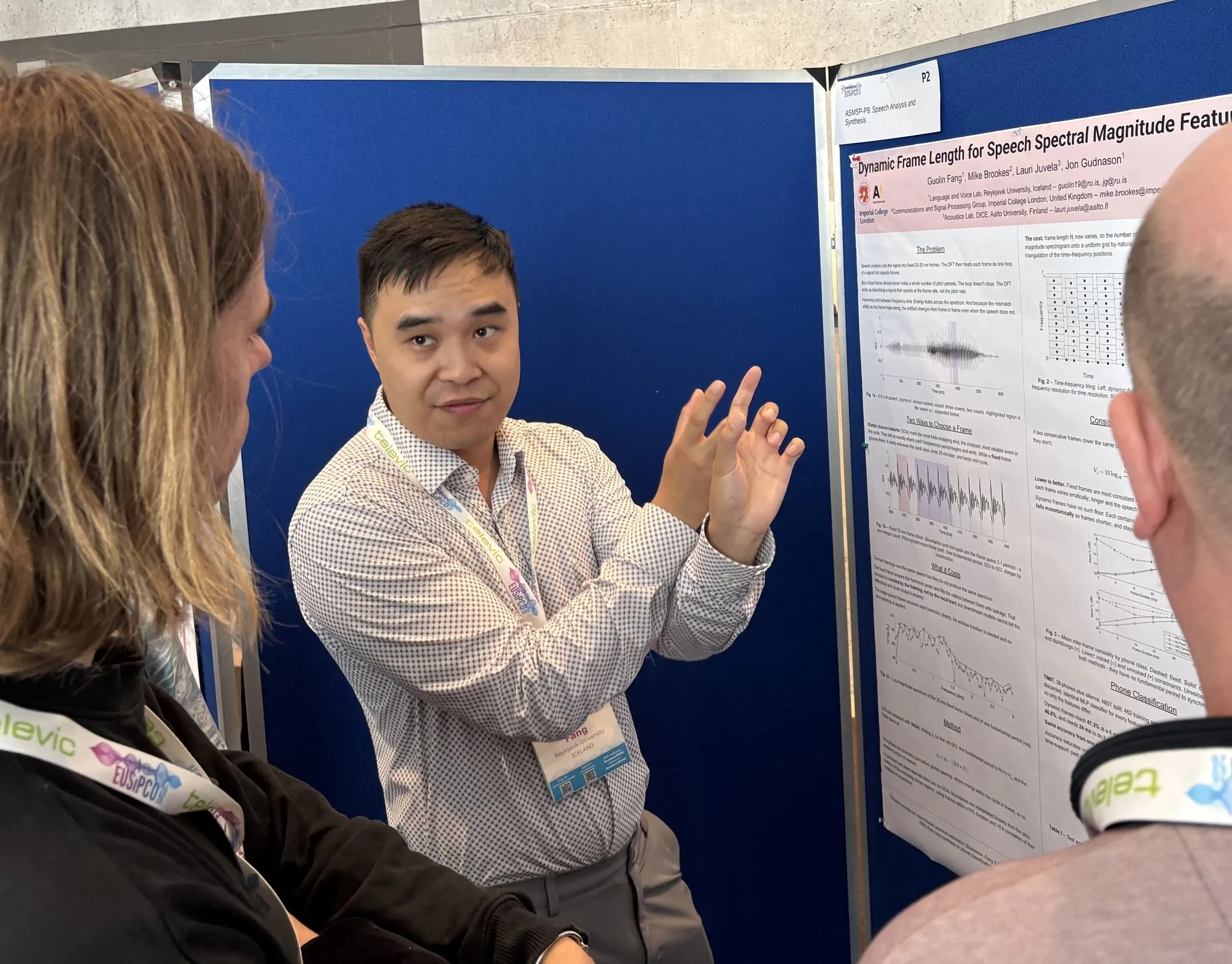
Guolin Fang presented our work on setting analysis frames from glottal closure instants rather than a fixed clock, and on the speech features that fall out of it.
The idea
If you want the Fourier coefficients of a periodic signal, you should analyse exactly one period of it. Classical speech processing does not. It cuts the signal into fixed-length frames and accepts the windowing and zero-padding distortion that follows. The convention is settled enough that it is rarely examined.
In this paper we set the extent of each frame from the glottal closure instants, so that a frame spans one pitch period. The frequency representation that results is free of distortion from windowing and zero-padding.
The fix brings its own problem. Periods differ in length, so the Fourier coefficient vectors do too, and the machinery downstream expects a feature of fixed size. We interpolate the coefficient magnitudes onto a common length and use that as the speech feature.
Evaluated on phone classification, the dynamic frames reach 47.3% at a resampled frame duration of 6 ms. The fixed-frame baseline reaches 46.8%, and needs 24 ms to get there — the same accuracy from a quarter of the time-support.
At the poster
Guolin had a steady stream of visitors, and the experimental design drew as much comment as the method itself — every feature set is fed to an identical classifier, so that nothing but the features differs between conditions.
This was the last session of the conference, so attendance was lower than at the start. Nevertheless, interest in the session was much stronger than I had expected.
Three generations on one paper
Guolin Fang, my PhD student at Reykjavík University, presented the work in the Speech Analysis and Synthesis poster session; I chaired it. The paper is joint with Mike Brookes at Imperial College London — my own PhD advisor, and a collaborator ever since — and Lauri Juvela at Aalto University.
The instants themselves come from YAGA, in Thomas, Guðnason and Naylor (2012) — the same algorithm that appeared on Tuesday’s keynote slide as the front end of a stroke assessment pipeline, which I wrote about earlier this week. Here it decides where a frame begins and ends. Two unrelated jobs for one piece of signal processing, both on show at the same conference.