EUSIPCO 2026: from glottal instants to stroke assessment
The opening keynote in Bruges argued that speech and acoustic processing is a fresh research area again while machine learning research has gone stale — illustrated, as it happened, with a pipeline resting on an algorithm we published in 2012.
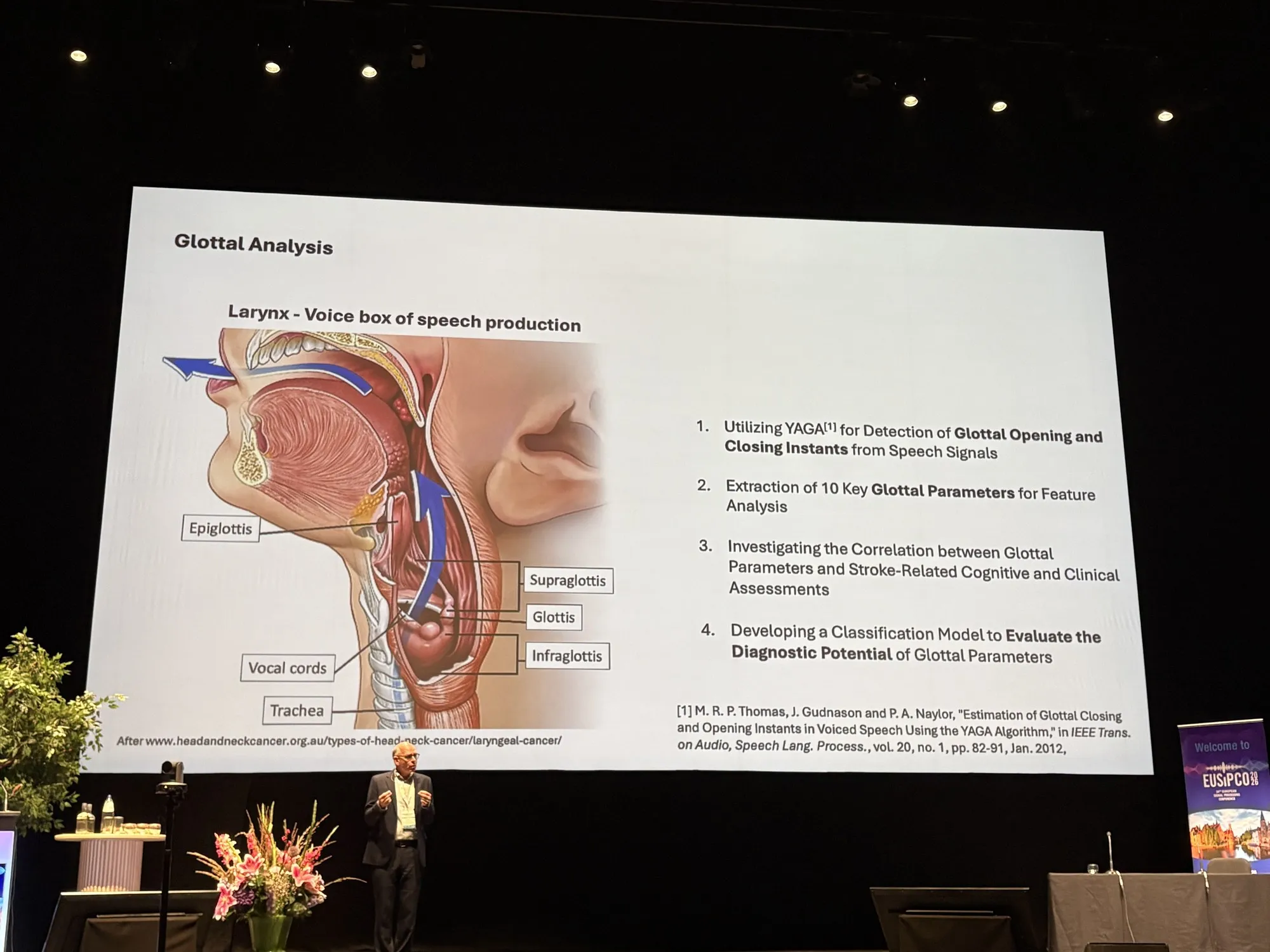
The argument
Patrick Naylor gave the opening keynote of EUSIPCO 2026 in Bruges this morning, on speech and acoustic signal processing using machine learning.
His argument, in short: speech and audio processing is a fresh research area again. New computational methods and new ways of acquiring data are opening questions that looked closed a decade ago. Machine learning research itself, by contrast, has gone stale — but applying machine learning where data is scarce remains genuinely open.
Both of his examples came from his students’ work: assessing brain injury after stroke from a patient’s voice, and internal learning for speech enhancement.
Where I stand
This aligns closely with how I think our field should orient itself. The AI revolution has produced a great many black boxes that solve already-defined engineering problems. That is useful, but our field was never only about solving problems; it was also about understanding the world. The science matters, mostly for its own sake — we are humans seeking knowledge — but also because unknown engineering problems present themselves as the science progresses.
From an algorithm to a clinical question
The first of those examples is work I have a hand in, and the slide in the photograph above sets out its method: detect glottal opening and closing instants, extract ten glottal parameters, correlate those with stroke-related cognitive and clinical assessments, then build a classification model to test their diagnostic value.
Step one runs on YAGA, from Thomas, Guðnason and Naylor (2012). The glottal strand of that stroke work is Sanguedolce et al. (2025), Physiologically-Informed Feature Analysis of Acquired Speech Disorders for Stroke Assessment.
That title is the argument in miniature. The ten glottal parameters carry physiological meaning, so a model built on them can be interrogated: one can ask which aspect of phonation changed after the stroke, rather than only how confident the classifier is. Fourteen years separate the algorithm from the clinical question it is now being asked.
Patrick supervised me as a research student and later as a post-doctoral researcher at Imperial College London. Both papers above are joint work with him.
Later that week the same algorithm appeared again, in our own paper at the same conference: one pitch period per frame.